
Creating a safe, secure, and equitable work culture is no longer just an ethical choice for modern organizations; it is a strict statutory mandates across India. The POSH Act 2013—officially enacted as the Sexual Harassment of Women at Workplace (Prevention, Prohibition and Redressal) Act, 2013—serves as the foundational legal framework designed to protect female employees from workplace misconduct. Achieving total POSH Act compliance requires proactive governance, detailed legal documentation, and continuous organizational commitment.
Navigating the nuances of POSH compliance in India can often feel overwhelming for HR leaders, legal counsel, and business owners. From establishing an Internal Committee under POSH Act to drafting a comprehensive POSH policy, organizations must adhere strictly to statutory provisions to prevent severe legal, financial, and reputational backlash.
This comprehensive guide breaks down the essential legal requirements, step-by-step procedures, and statutory mandates defined under Indian workplace sexual harassment law, helping your organization build an inclusive, compliant work environment.
1. What is the POSH Act 2013? Understanding the Legal Framework
The origin of the POSH Act 2013 stems from the landmark 1997 Supreme Court judgment in Vishaka vs. State of Rajasthan. Before this landmark case, women in India had no specific legislation addressing safety and harassment in professional settings. The Supreme Court established the historic “Vishaka Guidelines,” which ultimately laid the foundation for the formal enactment of the Prevention of Sexual Harassment at Workplace legislation in December 2013.
Key Objectives of the Law
- Prevention: Establishing preemptive safeguards, operational guidelines, and employee sensitization measures.
- Prohibition: Strictly barring any direct or indirect unwelcome sexual conduct within professional settings.
- Redressal: Mandating clear, confidential, and time-bound grievance mechanisms for aggrieved women.
Who is Covered Under the Act?
The scope of protection under the law is expansive:
- Aggrieved Woman: Any woman, regardless of her age, employment status, or designation (permanent, temporary, contractual, ad-hoc, trainee, or intern).
- Workplace Scope: Office premises, remote work environments, corporate transportation, off-site client meetings, official events, and digital communication channels (Slack, Microsoft Teams, email, Zoom).
Understanding the broad reach of the law ensures that businesses do not overlook non-traditional work environments or non-permanent staff in their compliance framework. To understand how structured human resource frameworks protect organizational health, explore our detailed resource on HR Advisory and Strategic Consulting Solutions.
2. What Constitutes Sexual Harassment Under the POSH Act?
To enforce effective preventive measures, employers must clearly define unacceptable behavior within their workplace guidelines. The statutory framework categorizes harassment into physical, verbal, non-verbal, and socio-professional dynamics.
Unwelcome Behaviors Defined
Under Section 2(n) of the Act, sexual harassment includes any of the following unwelcome acts or behavior (whether directly or by implication):
- Physical contact and advances.
- A demand or request for sexual favors.
- Making sexually colored remarks or offensive jokes.
- Showing pornography or explicit visual content.
- Any other unwelcome physical, verbal, or non-verbal conduct of a sexual nature.
Quid Pro Quo vs. Hostile Work Environment
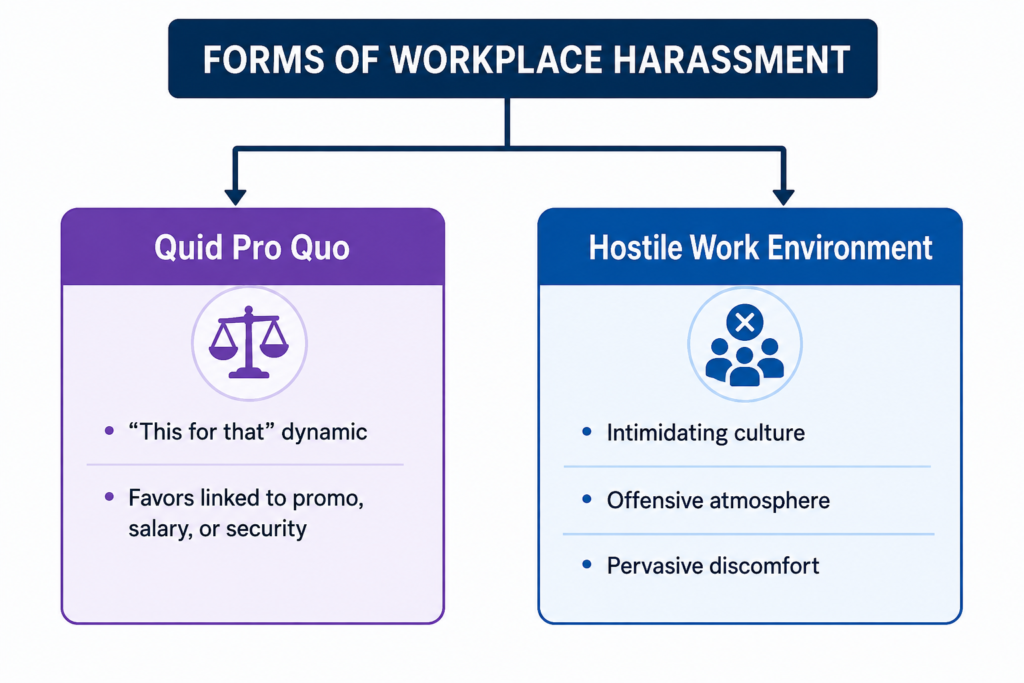
- Quid Pro Quo (“This for That”): Explicit or implicit promises of preferential treatment (promotions, pay raises) or threats of detrimental treatment (demotion, termination) in exchange for sexual favors.
- Hostile Work Environment: Creating an intimidating, offensive, or hostile work atmosphere that unreasonably interferes with a woman’s performance or creates an humiliating work environment.
Recognizing these subtle distinctions is vital for managers and internal evaluators during objective assessments.
3. Essential POSH Rules for Employers: Statutory Requirements
Indian legislation outlines explicit POSH rules for employers to ensure compliance across all operational locations. Ignorance of these statutory mandates exposes board members and directors to personal liability.
Summary of Mandatory Employer Duties
| Compliance Category | Key Requirement | Statutory Timeline / Detail |
| Internal Committee (IC) | Constitute IC for every branch with 10+ employees | Immediate upon reaching threshold |
| Policy Formulation | Draft and publish an explicit anti-sexual harassment policy | Annual review recommended |
| Employee Awareness | Conduct periodic training sessions and display IC contact notices | Minimum 1–2 workshops per year |
| Annual Filing | Submit statutory POSH Annual Report to the District Officer | Annually (by Dec 31 / Jan 31 based on district) |
| Capacity Building | Conduct specialized orientation workshops for IC members | Mandatory upon IC constitution/term renewal |
Fulfilling these requirements demands seamless collaboration between legal advisors, executive leadership, and internal HR units. Organizations seeking comprehensive workforce integration strategies can consult our guide on End-to-End Talent Acquisition and Recruitment Services.
4. Setting Up an Internal Committee (IC): Constitution & Responsibilities
Constituting a legally valid Internal Committee under POSH Act is the single most crucial operational requirement for employers. Any procedural flaw in the IC’s structure can invalidate its entire inquiry, leaving the employer exposed to legal challenges in High Courts.
Mandatory IC Composition
Every organization employing 10 or more employees across any branch or administrative unit must constitute an IC by a written order. The composition must strictly follow this legal structure:
- Presiding Officer: A woman employed at a senior level among the employees.
- Employee Members: Not less than two members from among employees, preferably committed to the cause of women or having legal knowledge/social work experience.
- External Member: One member from a non-governmental organization (NGO), association committed to the cause of women, or a person familiar with issues relating to sexual harassment.
- Gender Parity Rule: At least 50% of the total members nominated on the IC must be women.
Note on Term Limits: The Presiding Officer and every IC member hold office for a period not exceeding three years from the date of their nomination.
Role of the External Member
The external member provides unbiased guidance, neutral oversight, and specialized legal or procedural clarity. They ensure that internal company politics or management pressures do not compromise the integrity of the inquiry. Employers can consult official resources like the Ministry of Women and Child Development POSH Guidelines to review official statutory frameworks and external member criteria.
5. Step-by-Step Sexual Harassment Complaint & Inquiry Procedure
Handling complaints requires strict adherence to natural justice principles and exact statutory timelines. The sexual harassment complaint procedure follows precise, legally protected stages.
Phase 1: Filing the Formal Complaint
- Timeline: The aggrieved woman must file a written complaint within 3 months from the date of the incident (or the last incident in a series). The IC can extend this timeline by another 3 months if valid reasons prevented timely filing.
- Format: Six copies of the written complaint along with supporting documents and names/details of witnesses.
Phase 2: Conciliation Option
Before initiating a formal inquiry, the IC may, at the request of the aggrieved woman, take steps to settle the matter through informal conciliation.
- Condition: No monetary settlement can be made the basis of conciliation.
- Outcome: If a settlement is reached, recorded resolution copies are sent to the employer and both parties. No further inquiry is conducted unless terms are breached.
Phase 3: The Inquiry Process
If conciliation is not requested or fails, the IC initiates a formal inquiry following procedures similar to a civil court under the Code of Civil Procedure, 1908.
- Service of Notice: The IC forwards one copy of the complaint to the respondent within 7 working days.
- Reply Submission: The respondent must file a reply along with list of documents/witnesses within 10 working days.
- Inquiry Duration: The inquiry must be completed within 90 days.
- Principles of Natural Justice: Both parties receive fair opportunities to present evidence, call witnesses, and cross-examine written statements.
Interim Relief Options
During the pendency of an inquiry, upon a written request from the complainant, the IC may recommend:
- Transferring the complainant or respondent to another workplace.
- Granting leave to the aggrieved woman up to 3 months (in addition to her statutory leave allowance).
- Restraining the respondent from reporting on the complainant’s work performance or writing her confidential report.
6. The Importance of POSH Awareness and Training
Constitutional documentation alone does not guarantee a safe workplace environment. Regular POSH awareness and training programs are mandatory to build an inclusive culture and prevent workplace misconduct.
Employee Sensitization Programs
Employers must organize continuous, accessible workshops to educate workforce members on:
- What constitutes inappropriate workplace behavior.
- Redressal channels, confidentiality guarantees, and non-retaliation protections.
- The formal steps involved in lodging complaints.
IC Capacity Building Workshops
Because the IC acts as a quasi-judicial body, its members need specialized legal and investigative training covering:
- Gathering evidence and documenting proceedings objectively.
- Maintaining neutrality and managing conflict-of-interest situations.
- Conducting trauma-informed interviews while respecting natural justice principles.
- Drafting enforceable inquiry reports.
Organizations looking to enhance their corporate compliance standards can explore our customized framework for Executive Leadership Development and Corporate Training.
7. Penalties for Non-Compliance: Risks for Employers
Failing to maintain robust POSH Act compliance exposes companies to severe financial penalties, judicial scrutiny, and operational disruptions.
- Financial Fines: Direct penalty of up to ₹50,000 for failure to constitute an IC, non-formulation of policy, or non-submission of annual reports.
- Repeat Offenses: Cancellation, withdrawal, or non-renewal of business licenses or registration, along with doubled financial fines.
- Judicial Invalidation: High Courts frequently set aside flawed IC inquiries, ordering re-examinations or levying substantial damages against non-compliant employers.
- Reputational Damage: Media exposure or public disclosures regarding unsafe workplace environments damage employer branding and investor confidence.
For official details on labor rights and employer compliance frameworks, review resources provided by the Ministry of Labour and Employment, Government of India.
How Corise Consulting Helps You Achieve Seamless POSH Compliance
Establishing a fully compliant workplace requires specialized legal expertise, customized training programs, and neutral external representation. At Corise Consulting, we offer comprehensive end-to-end POSH compliance solutions tailored to your organization’s unique operational needs.
Our Core POSH Services
- POSH Policy Vetting & Drafting: Tailored, legally sound policies aligned with statutory requirements.
- External Member Provisioning: Empaneling certified, experienced external IC members to ensure objective inquiry processes.
- Employee Sensitization & IC Orientation: Engaging, interactive offline and online training workshops for staff and committee members.
- Inquiry Support & Documentation: Step-by-step guidance through complex investigations, ensuring full compliance with natural justice standards.
- Annual Audit & Filing Support: Timely preparation and submission of mandatory statutory reports to district authorities.
Partner with Corise Consulting today to protect your workforce, mitigate legal exposure, and build a culture of safety, equity, and trust.
Frequently Asked Questions (FAQs)
Q1. Is the POSH Act applicable to companies with fewer than 10 employees?
Yes, the underlying obligation to prevent sexual harassment applies to every employer regardless of size. However, organizations with fewer than 10 employees are not required to constitute an Internal Committee (IC). Complaints from such organizations are handled by the Local Committee (LC) established by the District Officer in each district.
Q2. Can a male employee file a complaint under the POSH Act 2013?
The POSH Act 2013 is a gender-specific law designed specifically to protect women in professional settings. However, modern employers can establish gender-neutral anti-harassment policies within their internal HR manuals to address complaints raised by male or non-binary employees.
Q3. Who can be appointed as an External Member in the Internal Committee?
An external member must be an individual from an NGO or association committed to the cause of women, a person familiar with issues relating to sexual harassment, or a legal expert holding deep operational knowledge of workplace safety frameworks.
Q4. What happens if an employee files a false or malicious complaint?
If the IC concludes after a full inquiry that a complaint was filed with malicious intent or that false evidence was produced, it may recommend action against the complainant in accordance with company service rules. However, an inability to substantiate a claim does not automatically imply malice.
Q5. What is the deadline for filing the POSH Annual Report?
The POSH Annual Report must be prepared by the IC and submitted to both the management and the designated District Officer by the statutory deadline (typically December 31st or January 31st, depending on local district rules).