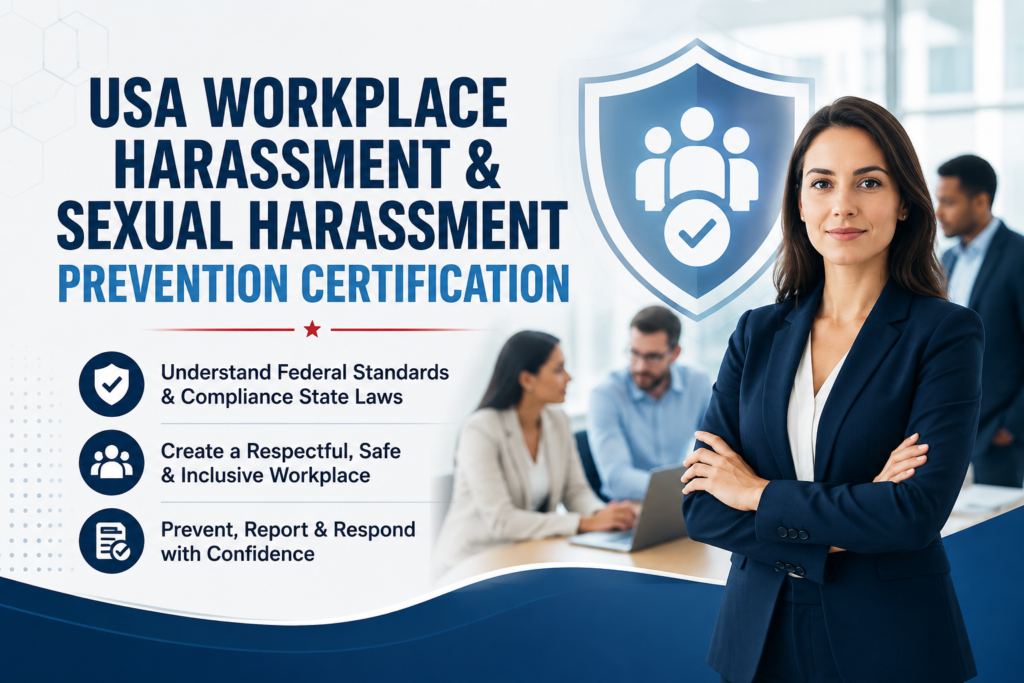
USA Workplace Harassment & Sexual Harassment Prevention Certification: Complete Guide to Workplace Compliance
Creating a respectful, safe, inclusive, and professional workplace is an essential part of modern organizational culture across the United States. Workplace harassment, sexual harassment, discrimination, retaliation, and inappropriate conduct negatively affect employees while creating significant operational, financial, and reputational risks. Securing a USA Workplace Harassment & Sexual Harassment Prevention Certification establishes a foundational standard of awareness and legal preparedness for modern organizations. What Is Workplace Harassment in the USA? Understanding the Legal Framework Workplace harassment involves unwelcome conduct based on protected characteristics established by federal employment discrimination statutes. The EEOC enforces federal laws including Title VII, the Age Discrimination in Employment Act (ADEA), and the Americans with Disabilities Act (ADA). Protected categories cover race, color, religion, sex, national origin, age (40 and older), disability, and genetic information. Core Objectives of Workplace Harassment Prevention What Constitutes Sexual Harassment Under U.S. Law? Sexual harassment involves unwelcome sexual advances, requests for favors, or explicit verbal and physical conduct. Digital Workplace Harassment Modern remote and hybrid working models create non-traditional avenues for misconduct. Digital harassment occurs across: Organizations must ensure that an online workplace harassment certification USA course explicitly covers proper digital conduct. Quid Pro Quo and Hostile Work Environment Understanding different forms of sexual harassment is essential for supervisors and staff. Quid Pro Quo Quid pro quo situations occur when tangible employment decisions depend on an employee’s submission to unwelcome sexual advances. Examples include promising a promotion in exchange for sexual favors or threatening termination if advances are rejected. Completing a targeted Title VII sexual harassment prevention course helps managers recognize these severe violations immediately. Hostile Work Environment A hostile work environment arises when unwelcome conduct based on a protected category is severe or pervasive enough to alter working conditions and create an intimidating or abusive atmosphere. Organizations can and should establish internal policies prohibiting inappropriate conduct even before it reaches the legal standard of unlawful harassment. Who Can Experience or Commit Workplace Harassment? Workplace harassment rules apply across all operational tiers. Individuals who may experience harassment: Individuals who may commit harassment: The harasser and the impacted party can be of the same or different sexes. Moreover, a person affected by workplace conduct does not necessarily have to be the direct target of the behavior. Title VII of the Civil Rights Act of 1964 Title VII is the primary federal statutory framework regulating sexual harassment in employment. Employer Coverage Title VII applies to private employers, state and local governments, and educational institutions with 15 or more employees. Enrolling personnel in a specialized Title VII harassment course ensures compliance with these core federal standards. Federal vs. State Requirements Federal standards set the regulatory floor, but state and local jurisdictions often impose stricter training rules. Jurisdiction Threshold Frequency Supervisor Specifics Federal Law 15+ Employees Recommended General Guidance California 5+ Employees Every 2 Years 2 Hours Required New York State 1+ Employees Annual Interactive Required Illinois 1+ Employees Annual Industry-Specific Rules Enrolling employees in a self-paced sexual harassment prevention course USA helps companies easily manage multi-state training requirements. Essential Workplace Harassment Prevention Practices An effective compliance strategy requires structured organizational policies. Prevention Area Key Organizational Practice Anti-Harassment Policy Clearly communicate prohibited conduct and boundaries Reporting Channels Provide multiple accessible ways to submit complaints Investigation Conduct prompt, impartial, and thorough reviews Non-Retaliation Explicitly protect employees who report misconduct Employee Awareness Utilize a workplace harassment prevention course USA Workplace Harassment Complaint and Response Process For additional legal resources and regulatory updates, visit the official U.S. Department of Labor Compliance Portal. Confidentiality and Protection Against Retaliation Confidentiality must be maintained to the greatest extent possible during an investigation. However, absolute secrecy cannot be guaranteed when an effective, impartial review requires sharing details with relevant witnesses. Retaliation includes any adverse employment action taken against an individual for reporting misconduct or participating in an investigation. Prohibiting retaliation is a cornerstone of an effective USA workplace harassment certification program. Importance of USA Workplace Harassment Prevention Learning Structured training ensures employees understand behavioral expectations while strengthening overall compliance defense. Key Learning Topics Review industry insights and corporate compliance articles on the official Corise Consulting Blog. Self-Paced USA Workplace Harassment & Sexual Harassment Prevention Certification Our program offers flexible, self-paced learning designed to educate modern teams. Course Features Who Can Take the USA Workplace Harassment Certification Course? This program is tailored for: For individualized compliance evaluations, access our direct Corise Consulting Services page. Workplace Harassment Prevention in Remote and Hybrid Workplaces Remote setups present distinct communication challenges. Online meetings, team messaging apps, and personal digital interactions can blur professional boundaries. A modern USA workplace harassment and sexual harassment prevention certification program provides clear rules of conduct for virtual environments. Risks of Inadequate Workplace Harassment Prevention Failing to maintain proactive anti-harassment training exposes organizations to severe legal and financial risks: Building a Respectful Workplace Culture Sustained compliance requires commitment from all organizational levels. Secure Your Organization with Corise Consulting Building a compliant, respectful workplace requires the right educational tools and strategic oversight. At Corise Consulting, we provide professional, state-aligned, and engaging compliance solutions designed to protect your organization while empowering your workforce. Our services include: Protect your company culture and eliminate legal exposure. Contact Corise Consulting Today to speak with our compliance specialists! Frequently Asked Questions (FAQs) Q1. What is the USA Workplace Harassment & Sexual Harassment Prevention Certification? It is a self-paced online learning course that covers legal frameworks, sexual harassment prevention, reporting mechanisms, and non-retaliation policies under U.S. federal and state laws. Q2. Is this a live training program? No. The course is an asynchronous, self-paced online program. Learners complete modules, interactive scenarios, and assessments on their own schedule. Q3. What law is primary for sexual harassment in the USA? Title VII of the Civil Rights Act of 1964 is the primary federal law prohibiting sexual harassment as a form of sex discrimination for employers with 15 or more employees. Q4. Does federal law mandate identical training for every employer? Federal law encourages training to establish an affirmative legal defense, but specific