coriseconsulting.com

Author name: shiv.nucleosys@gmail.com

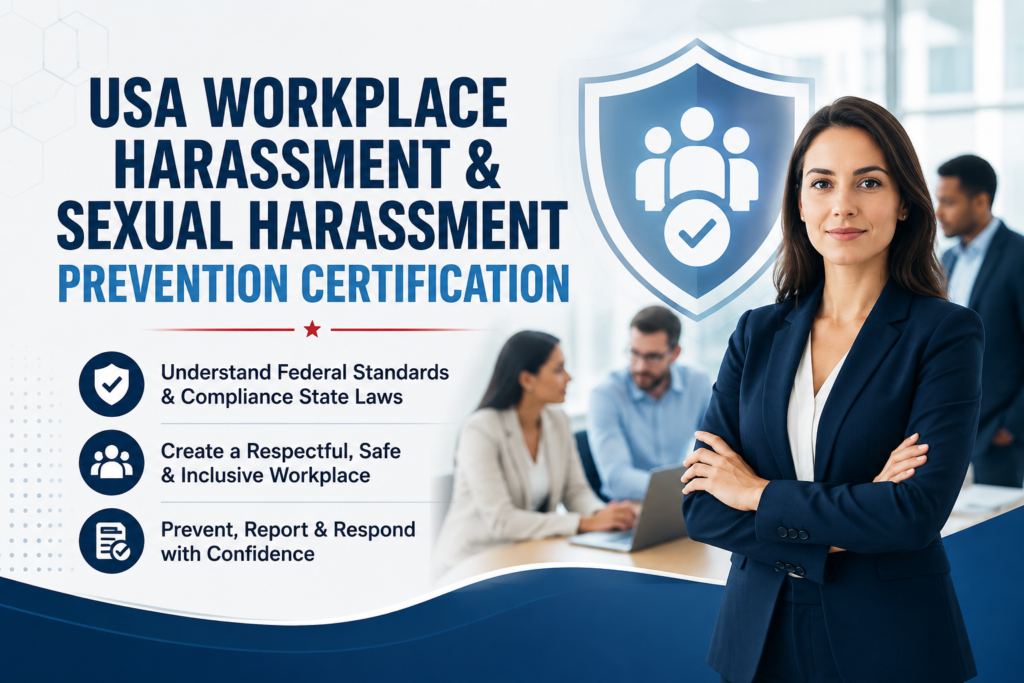
workplace harassment prevention certification
Blog

USA Workplace Harassment & Sexual Harassment Prevention Certification: Complete Guide to Workplace Compliance

Creating a respectful, safe, inclusive, and professional workplace is an essential part of modern organizational culture across the United States. Workplace harassment, sexual harassment, discrimination, retaliation, and inappropriate conduct negatively affect employees while creating significant operational, financial, and reputational risks. Securing a USA Workplace Harassment & Sexual Harassment Prevention Certification establishes a foundational standard of awareness and legal preparedness for modern organizations. What Is Workplace Harassment in the USA? Understanding the Legal Framework Workplace harassment involves unwelcome conduct based on protected characteristics established by federal employment discrimination statutes. The EEOC enforces federal laws including Title VII, the Age Discrimination in Employment Act (ADEA), and the Americans with Disabilities Act (ADA). Protected categories cover race, color, religion, sex, national origin, age (40 and older), disability, and genetic information. Core Objectives of Workplace Harassment Prevention What Constitutes Sexual Harassment Under U.S. Law? Sexual harassment involves unwelcome sexual advances, requests for favors, or explicit verbal and physical conduct. Digital Workplace Harassment Modern remote and hybrid working models create non-traditional avenues for misconduct. Digital harassment occurs across: Organizations must ensure that an online workplace harassment certification USA course explicitly covers proper digital conduct. Quid Pro Quo and Hostile Work Environment Understanding different forms of sexual harassment is essential for supervisors and staff. Quid Pro Quo Quid pro quo situations occur when tangible employment decisions depend on an employee’s submission to unwelcome sexual advances. Examples include promising a promotion in exchange for sexual favors or threatening termination if advances are rejected. Completing a targeted Title VII sexual harassment prevention course helps managers recognize these severe violations immediately. Hostile Work Environment A hostile work environment arises when unwelcome conduct based on a protected category is severe or pervasive enough to alter working conditions and create an intimidating or abusive atmosphere. Organizations can and should establish internal policies prohibiting inappropriate conduct even before it reaches the legal standard of unlawful harassment. Who Can Experience or Commit Workplace Harassment? Workplace harassment rules apply across all operational tiers. Individuals who may experience harassment: Individuals who may commit harassment: The harasser and the impacted party can be of the same or different sexes. Moreover, a person affected by workplace conduct does not necessarily have to be the direct target of the behavior. Title VII of the Civil Rights Act of 1964 Title VII is the primary federal statutory framework regulating sexual harassment in employment. Employer Coverage Title VII applies to private employers, state and local governments, and educational institutions with 15 or more employees. Enrolling personnel in a specialized Title VII harassment course ensures compliance with these core federal standards. Federal vs. State Requirements Federal standards set the regulatory floor, but state and local jurisdictions often impose stricter training rules. Jurisdiction Threshold Frequency Supervisor Specifics Federal Law 15+ Employees Recommended General Guidance California 5+ Employees Every 2 Years 2 Hours Required New York State 1+ Employees Annual Interactive Required Illinois 1+ Employees Annual Industry-Specific Rules Enrolling employees in a self-paced sexual harassment prevention course USA helps companies easily manage multi-state training requirements. Essential Workplace Harassment Prevention Practices An effective compliance strategy requires structured organizational policies. Prevention Area Key Organizational Practice Anti-Harassment Policy Clearly communicate prohibited conduct and boundaries Reporting Channels Provide multiple accessible ways to submit complaints Investigation Conduct prompt, impartial, and thorough reviews Non-Retaliation Explicitly protect employees who report misconduct Employee Awareness Utilize a workplace harassment prevention course USA Workplace Harassment Complaint and Response Process For additional legal resources and regulatory updates, visit the official U.S. Department of Labor Compliance Portal. Confidentiality and Protection Against Retaliation Confidentiality must be maintained to the greatest extent possible during an investigation. However, absolute secrecy cannot be guaranteed when an effective, impartial review requires sharing details with relevant witnesses. Retaliation includes any adverse employment action taken against an individual for reporting misconduct or participating in an investigation. Prohibiting retaliation is a cornerstone of an effective USA workplace harassment certification program. Importance of USA Workplace Harassment Prevention Learning Structured training ensures employees understand behavioral expectations while strengthening overall compliance defense. Key Learning Topics Review industry insights and corporate compliance articles on the official Corise Consulting Blog. Self-Paced USA Workplace Harassment & Sexual Harassment Prevention Certification Our program offers flexible, self-paced learning designed to educate modern teams. Course Features Who Can Take the USA Workplace Harassment Certification Course? This program is tailored for: For individualized compliance evaluations, access our direct Corise Consulting Services page. Workplace Harassment Prevention in Remote and Hybrid Workplaces Remote setups present distinct communication challenges. Online meetings, team messaging apps, and personal digital interactions can blur professional boundaries. A modern USA workplace harassment and sexual harassment prevention certification program provides clear rules of conduct for virtual environments. Risks of Inadequate Workplace Harassment Prevention Failing to maintain proactive anti-harassment training exposes organizations to severe legal and financial risks: Building a Respectful Workplace Culture Sustained compliance requires commitment from all organizational levels. Secure Your Organization with Corise Consulting Building a compliant, respectful workplace requires the right educational tools and strategic oversight. At Corise Consulting, we provide professional, state-aligned, and engaging compliance solutions designed to protect your organization while empowering your workforce. Our services include: Protect your company culture and eliminate legal exposure. Contact Corise Consulting Today to speak with our compliance specialists! Frequently Asked Questions (FAQs) Q1. What is the USA Workplace Harassment & Sexual Harassment Prevention Certification? It is a self-paced online learning course that covers legal frameworks, sexual harassment prevention, reporting mechanisms, and non-retaliation policies under U.S. federal and state laws. Q2. Is this a live training program? No. The course is an asynchronous, self-paced online program. Learners complete modules, interactive scenarios, and assessments on their own schedule. Q3. What law is primary for sexual harassment in the USA? Title VII of the Civil Rights Act of 1964 is the primary federal law prohibiting sexual harassment as a form of sex discrimination for employers with 15 or more employees. Q4. Does federal law mandate identical training for every employer? Federal law encourages training to establish an affirmative legal defense, but specific
POSH Act 2013
Blog

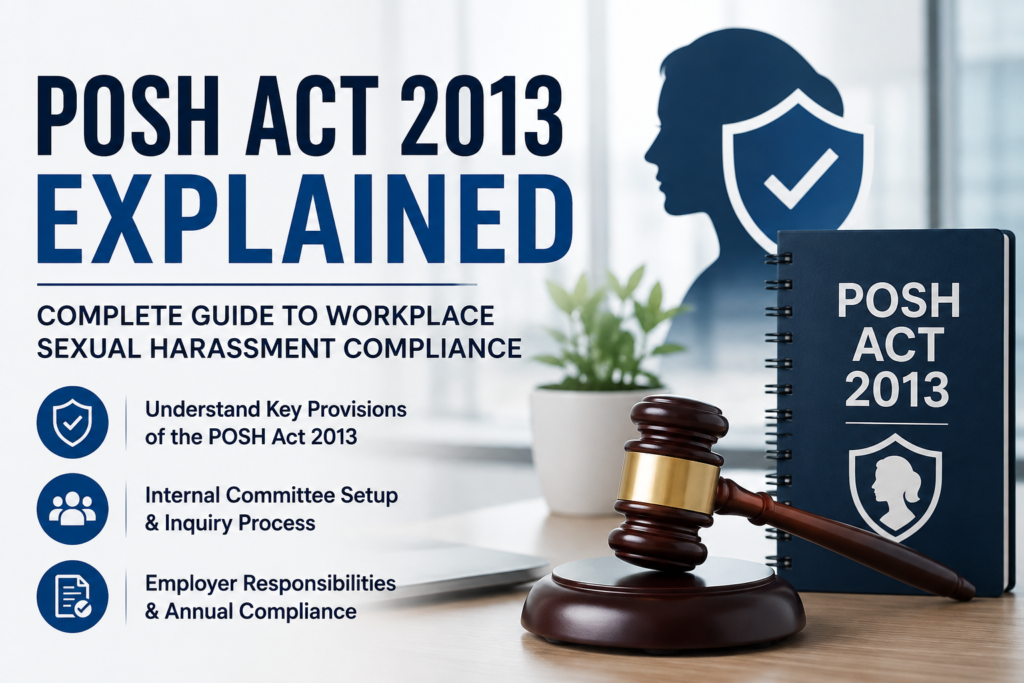
POSH Act 2013 Explained: Complete Guide to Workplace Sexual Harassment Compliance

Creating a safe, secure, and equitable work culture is no longer just an ethical choice for modern organizations; it is a strict statutory mandates across India. The POSH Act 2013—officially enacted as the Sexual Harassment of Women at Workplace (Prevention, Prohibition and Redressal) Act, 2013—serves as the foundational legal framework designed to protect female employees from workplace misconduct. Achieving total POSH Act compliance requires proactive governance, detailed legal documentation, and continuous organizational commitment. Navigating the nuances of POSH compliance in India can often feel overwhelming for HR leaders, legal counsel, and business owners. From establishing an Internal Committee under POSH Act to drafting a comprehensive POSH policy, organizations must adhere strictly to statutory provisions to prevent severe legal, financial, and reputational backlash. This comprehensive guide breaks down the essential legal requirements, step-by-step procedures, and statutory mandates defined under Indian workplace sexual harassment law, helping your organization build an inclusive, compliant work environment. 1. What is the POSH Act 2013? Understanding the Legal Framework The origin of the POSH Act 2013 stems from the landmark 1997 Supreme Court judgment in Vishaka vs. State of Rajasthan. Before this landmark case, women in India had no specific legislation addressing safety and harassment in professional settings. The Supreme Court established the historic “Vishaka Guidelines,” which ultimately laid the foundation for the formal enactment of the Prevention of Sexual Harassment at Workplace legislation in December 2013. Key Objectives of the Law Who is Covered Under the Act? The scope of protection under the law is expansive: Understanding the broad reach of the law ensures that businesses do not overlook non-traditional work environments or non-permanent staff in their compliance framework. To understand how structured human resource frameworks protect organizational health, explore our detailed resource on HR Advisory and Strategic Consulting Solutions. 2. What Constitutes Sexual Harassment Under the POSH Act? To enforce effective preventive measures, employers must clearly define unacceptable behavior within their workplace guidelines. The statutory framework categorizes harassment into physical, verbal, non-verbal, and socio-professional dynamics. Unwelcome Behaviors Defined Under Section 2(n) of the Act, sexual harassment includes any of the following unwelcome acts or behavior (whether directly or by implication): Quid Pro Quo vs. Hostile Work Environment Recognizing these subtle distinctions is vital for managers and internal evaluators during objective assessments. 3. Essential POSH Rules for Employers: Statutory Requirements Indian legislation outlines explicit POSH rules for employers to ensure compliance across all operational locations. Ignorance of these statutory mandates exposes board members and directors to personal liability. Summary of Mandatory Employer Duties Compliance Category Key Requirement Statutory Timeline / Detail Internal Committee (IC) Constitute IC for every branch with 10+ employees Immediate upon reaching threshold Policy Formulation Draft and publish an explicit anti-sexual harassment policy Annual review recommended Employee Awareness Conduct periodic training sessions and display IC contact notices Minimum 1–2 workshops per year Annual Filing Submit statutory POSH Annual Report to the District Officer Annually (by Dec 31 / Jan 31 based on district) Capacity Building Conduct specialized orientation workshops for IC members Mandatory upon IC constitution/term renewal Fulfilling these requirements demands seamless collaboration between legal advisors, executive leadership, and internal HR units. Organizations seeking comprehensive workforce integration strategies can consult our guide on End-to-End Talent Acquisition and Recruitment Services. 4. Setting Up an Internal Committee (IC): Constitution & Responsibilities Constituting a legally valid Internal Committee under POSH Act is the single most crucial operational requirement for employers. Any procedural flaw in the IC’s structure can invalidate its entire inquiry, leaving the employer exposed to legal challenges in High Courts. Mandatory IC Composition Every organization employing 10 or more employees across any branch or administrative unit must constitute an IC by a written order. The composition must strictly follow this legal structure: Note on Term Limits: The Presiding Officer and every IC member hold office for a period not exceeding three years from the date of their nomination. Role of the External Member The external member provides unbiased guidance, neutral oversight, and specialized legal or procedural clarity. They ensure that internal company politics or management pressures do not compromise the integrity of the inquiry. Employers can consult official resources like the Ministry of Women and Child Development POSH Guidelines to review official statutory frameworks and external member criteria. 5. Step-by-Step Sexual Harassment Complaint & Inquiry Procedure Handling complaints requires strict adherence to natural justice principles and exact statutory timelines. The sexual harassment complaint procedure follows precise, legally protected stages. Phase 1: Filing the Formal Complaint Phase 2: Conciliation Option Before initiating a formal inquiry, the IC may, at the request of the aggrieved woman, take steps to settle the matter through informal conciliation. Phase 3: The Inquiry Process If conciliation is not requested or fails, the IC initiates a formal inquiry following procedures similar to a civil court under the Code of Civil Procedure, 1908. Interim Relief Options During the pendency of an inquiry, upon a written request from the complainant, the IC may recommend: 6. The Importance of POSH Awareness and Training Constitutional documentation alone does not guarantee a safe workplace environment. Regular POSH awareness and training programs are mandatory to build an inclusive culture and prevent workplace misconduct. Employee Sensitization Programs Employers must organize continuous, accessible workshops to educate workforce members on: IC Capacity Building Workshops Because the IC acts as a quasi-judicial body, its members need specialized legal and investigative training covering: Organizations looking to enhance their corporate compliance standards can explore our customized framework for Executive Leadership Development and Corporate Training. 7. Penalties for Non-Compliance: Risks for Employers Failing to maintain robust POSH Act compliance exposes companies to severe financial penalties, judicial scrutiny, and operational disruptions. For official details on labor rights and employer compliance frameworks, review resources provided by the Ministry of Labour and Employment, Government of India. How Corise Consulting Helps You Achieve Seamless POSH Compliance Establishing a fully compliant workplace requires specialized legal expertise, customized training programs, and neutral external representation. At Corise Consulting, we offer comprehensive end-to-end POSH compliance solutions tailored to your organization’s

Uncategorized

Celebrating Women’s Day: Building Inclusive and Respectful Workplaces

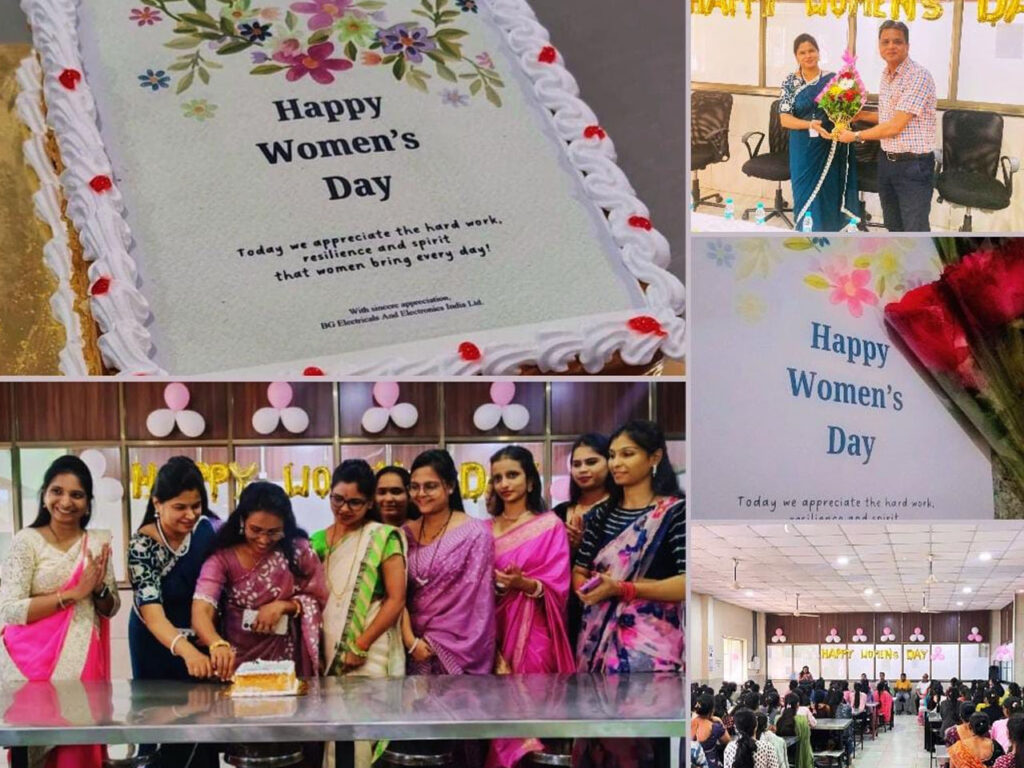
Women’s Day as a Reminder of Workplace Equality International Women’s Day is more than a celebration—it is an opportunity for organizations to reaffirm their commitment to gender equality, inclusivity, and employee wellbeing. Corise Consulting recently participated in a Women’s Day awareness and engagement program that brought together employees to discuss workplace inclusion, respect, leadership opportunities, and the importance of creating a supportive environment for women professionals. The event encouraged meaningful conversations around diversity, workplace culture, and professional growth. Why Workplace Inclusion Matters Organizations that promote gender diversity and equal opportunities often experience: Higher employee engagement Better team collaboration Improved innovation and creativity Stronger organizational culture Increased employee retention An inclusive workplace allows individuals from all backgrounds to contribute confidently and reach their full potential. Key Discussions During the Session The program focused on topics that are increasingly important in modern workplaces: Gender Equality at Work Creating equal opportunities for career growth, leadership development, and professional advancement. Respectful Workplace Culture Encouraging professional conduct, mutual respect, and zero tolerance toward discrimination and harassment. Employee Wellbeing Supporting mental health, work-life balance, and employee satisfaction. Women’s Leadership Recognizing the growing role of women leaders in driving organizational success and innovation. The Connection Between DEI and Business Success Diversity, Equity, and Inclusion (DEI) initiatives are no longer optional for forward-thinking organizations. Research consistently shows that diverse teams make better decisions, solve problems more effectively, and create stronger workplace cultures. Benefits include: Improved employee morale Better employer branding Enhanced productivity Stronger customer relationships Greater organizational resilience Creating Lasting Impact Beyond Celebrations While special events and celebrations are valuable, true inclusion requires continuous effort throughout the year. Organizations should focus on: Regular DEI awareness programs Gender sensitization workshops Leadership development opportunities POSH awareness training Equal opportunity policies Employee engagement initiatives These efforts help create workplaces where every employee feels valued, respected, and empowered. Corise Consulting’s Approach to Workplace Inclusion Corise Consulting partners with organizations to build safer, stronger, and smarter workplaces through: DEI Awareness Programs Gender Sensitization Workshops POSH Awareness Training Leadership Development Sessions Internal Committee Training Workplace Culture Transformation Programs Our goal is to help organizations foster environments where diversity is celebrated and inclusion becomes part of everyday workplace culture. Conclusion Women’s Day serves as an important reminder that inclusive workplaces are built through continuous commitment, awareness, and action. By investing in diversity and employee wellbeing, organizations can create stronger teams, better workplace experiences, and sustainable long-term success.

Uncategorized

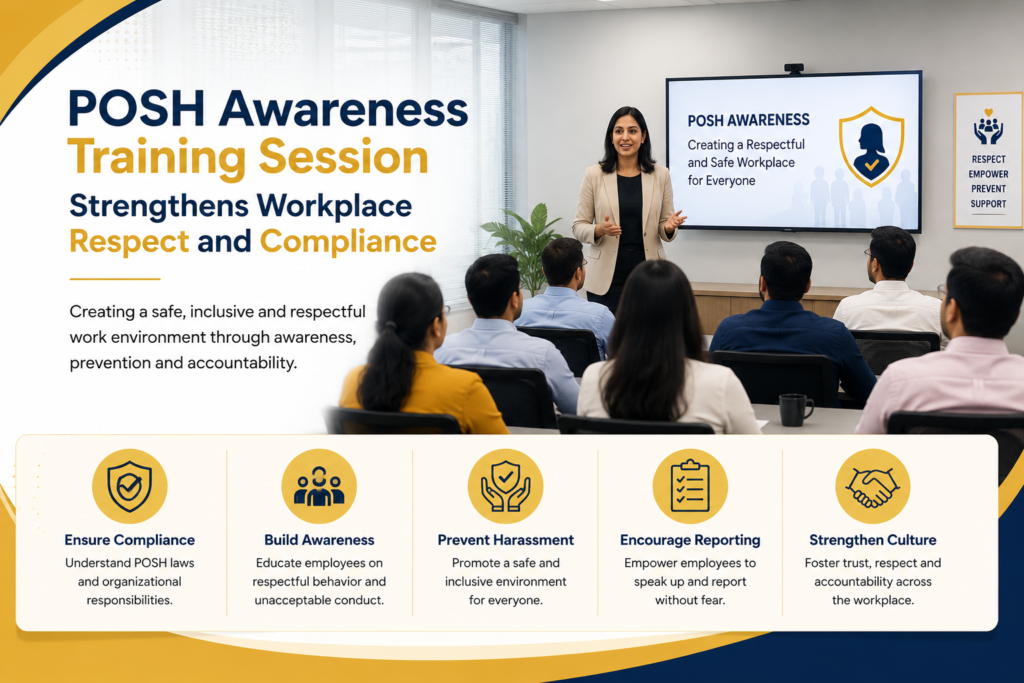
POSH Awareness Training Session Strengthens Workplace Respect and Compliance

Introduction A safe and respectful workplace is essential for employee wellbeing, productivity, and organizational growth. Corise Consulting recently conducted an engaging POSH Awareness Training Session aimed at helping employees understand their rights, responsibilities, and the importance of maintaining a harassment-free work environment. The session brought together employees from various departments and focused on building awareness around workplace conduct, professional behavior, and the legal provisions of the Prevention of Sexual Harassment (POSH) Act, 2013. Understanding the POSH Act During the session, participants were introduced to the key provisions of the POSH Act and the responsibilities of both employers and employees. Topics covered included: Understanding workplace sexual harassment Types of inappropriate workplace behavior Rights of employees under the POSH Act Responsibilities of organizations Role of the Internal Committee (IC) Complaint reporting procedures Confidentiality and investigation process The training emphasized that prevention begins with awareness and that every employee plays a role in creating a respectful workplace culture. Interactive Learning Approach The session was conducted using practical examples, workplace scenarios, and real-life case studies. Participants actively engaged in discussions and raised questions related to workplace interactions, communication boundaries, and complaint procedures. This interactive format helped employees better understand: Acceptable workplace conduct Professional communication standards Respectful behavior in physical and virtual workplaces Bystander responsibilities Reporting mechanisms available within the organization Why POSH Awareness Matters Organizations that invest in regular POSH training experience numerous benefits, including: Improved Employee Confidence Employees feel safer knowing that the organization takes workplace safety seriously. Stronger Workplace Culture Awareness programs encourage mutual respect, inclusivity, and professionalism. Legal Compliance Regular POSH training helps organizations meet statutory requirements under the POSH Act. Reduced Workplace Conflicts Employees gain a better understanding of appropriate workplace behavior and boundaries. Building a Culture of Respect POSH compliance is not merely a legal requirement—it is a commitment to creating a workplace where every employee feels valued, respected, and protected. Awareness sessions help organizations move beyond compliance and build a culture based on dignity, equality, and mutual respect. How Corise Consulting Supports Organizations Corise Consulting provides comprehensive workplace compliance solutions including: POSH Awareness Training Internal Committee (IC) Member Training POSH Policy Development Compliance Audits Gender Sensitization Programs DEI Awareness Workshops Annual Refresher Sessions Our programs are designed to ensure organizations remain compliant while fostering a positive and inclusive work environment. Conclusion POSH awareness training is one of the most effective ways to prevent workplace harassment and promote a culture of respect. Through continuous education and engagement, organizations can create safer workplaces where employees can thrive professionally and personally.

Uncategorized

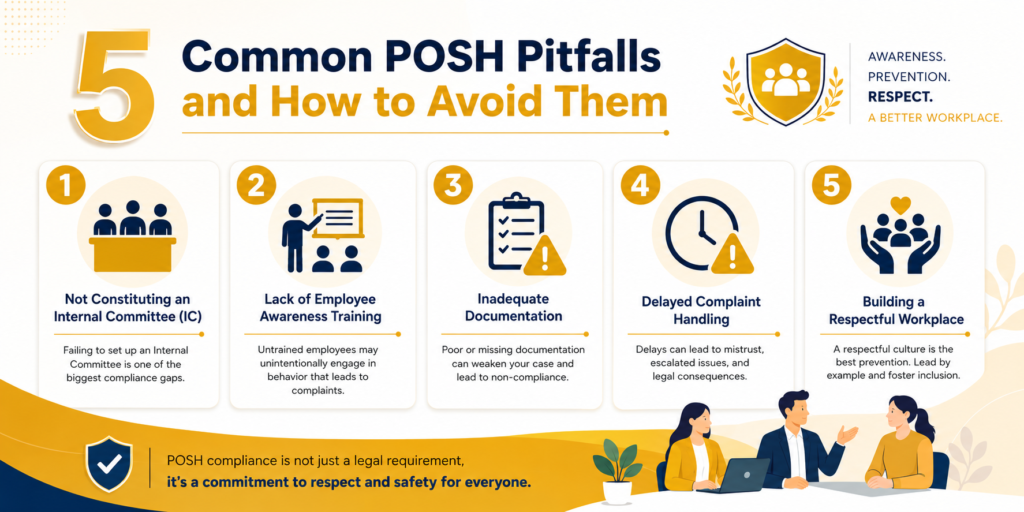
5 Common POSH Pitfalls and How to Avoid Them

Introduction The Prevention of Sexual Harassment (POSH) Act, 2013 was introduced to ensure a safe, respectful, and inclusive workplace for all employees. While many organizations have implemented POSH policies, several continue to face compliance gaps that can expose them to legal risks, reputational damage, and employee dissatisfaction. Understanding the most common POSH mistakes can help organizations build a stronger culture of safety and compliance. 1. Not Constituting an Internal Committee (IC) One of the most common compliance failures is the absence of a properly constituted Internal Committee.According to the POSH Act, every organization with 10 or more employees must establish an Internal Committee to handle complaints related to workplace sexual harassment.✅Common Mistakes:No Internal Committee formedIncorrect composition of committee membersMissing external memberExpired committee tenure✅How to Avoid:Appoint an IC immediately after crossing 10 employees.Ensure the committee consists of trained members.Include an external member as mandated by law.Review committee composition annually. 2. Lack of Employee Awareness Training Many organizations create a POSH policy but fail to educate employees about it.Employees who are unaware of their rights and responsibilities may hesitate to report incidents or may unintentionally violate workplace conduct standards. ◾How to Avoid:– Conduct annual POSH awareness sessions.– Include POSH training during employee onboarding.– Use real-life workplace scenarios.– Maintain attendance records for compliance audits. 3. Inadequate Documentation POSH compliance is not a one-time exercise. It requires continuous awareness, monitoring, and improvement.Organizations that conduct training only when required often fail to build a sustainable culture of respect. Best Practices: Schedule annual refresher training. Review policies regularly. Conduct employee feedback surveys. Evaluate workplace culture and risks periodically. Building a Respectful Workplace A compliant workplace is not only about avoiding penalties—it is about creating an environment where employees feel safe, respected, and empowered to perform their best.Organizations that invest in regular POSH awareness, strong Internal Committees, and transparent complaint mechanisms build stronger teams, improve employee trust, and enhance overall productivity. Conclusion POSH compliance is both a legal obligation and a business necessity. By addressing these common pitfalls, organizations can reduce risks, strengthen workplace culture, and demonstrate their commitment to employee wellbeing. At Corise Consulting, we help organizations implement effective POSH frameworks through awareness programs, Internal Committee training, compliance audits, policy development, and workplace sensitization initiatives.

Scroll to Top